Describing Soil Profiles
Soil Study Areas
Describing Soil Profiles
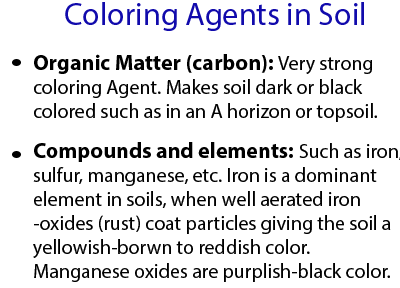
Gray colors will exist in soils that are not well drained. These gray colors are developed by the reduction and movement of iron in wet areas of the soil. As iron moves, the reddish or brownish color disappears, leaving behind gray colors. In general, these spots of gray color are called mottles.
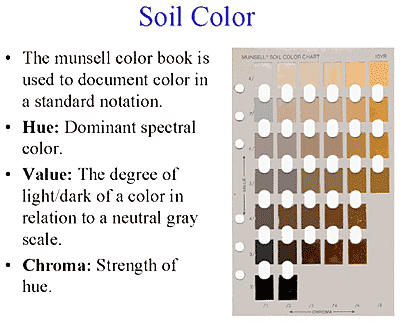
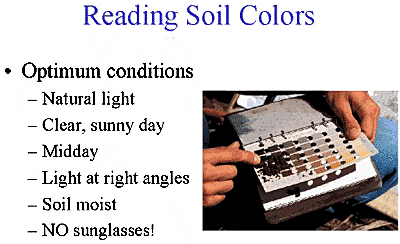
The hue is determined by the numbers and letters in the upper right-hand corner of the page. The page given above represents hue 10YR. Most soils in West Virginia have hues of 10YR. The value is represented by the numbers given on the left side of the page, and they are read vertically. Chroma is given across the bottom of the page and is read horizontally. So, an example of a proper Munsell designation is 10YR 5/6. Students should refer to the Soil Survey of Lewis County to determine how these colors are used in profile descriptions.
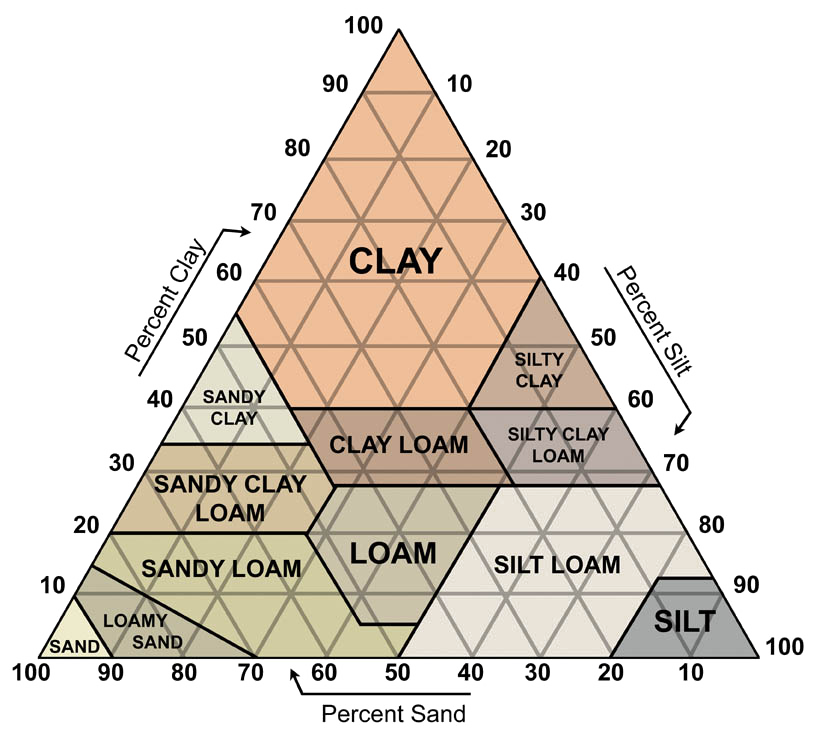
Soil texture is defined as the relative proportion of sand, silt, and clay. Particle sizes for each fraction are as follows:
- 1. Rock Fragments >2 mm
- Sand 2 - 0.05 mm
- Silt 0.05 - 0.002 mm
- Clay < 0.002 mm
- Water-holding capacity
- Ability to store nutrients
- Movement of water into and through the soil (pollutant leaching potential)
- Erodibility
- Shrink-swell potential
Soil texture will be determined in the field by the feel method. Texture classes in the United States are represented by the texture triangle presented below. Flowcharts to assist in determining texture can be found at: http://cmase.pbworks.com/f/Soil+Texture+By+Feel.pdf.
Additional information may be found at:
http://www.ext.colostate.edu/mg/gardennotes/214.html
https://www.nrcs.usda.gov/wps/portal/nrcs/detail/soils/edu/?cid=nrcs142p2_054311
http://www.fao.org/fishery/static/FAO_Training/FAO_Training/General/x6706e/x6706e06.htm
http://passel.unl.edu/pages/informationmodule.php?idinformationmodule=1130447039&topicorder=2
Soil structure is defined as the combination or arrangement of primary particles into secondary units called peds. Soil structure is important because it affects water infiltration and movement through the soil, heat transfer, and aeration. Additions of organic matter will improve soil structure.
Types of structure in soils include granular, blocky, prismatic, columnar, and platy. Soils without a specific type of structure are called structureless and may be single grain or massive.
Additional information may be found at:
http://www.agriinfo.in/default.aspx?page=topic&superid=4&topicid=267
http://www.deeproot.com/blog/blog-entries/what-is-soil-structure-and-why-is-it-important
https://www.sciencedirect.com/topics/agricultural-and-biological-sciences/soil-structure
https://www.nrcs.usda.gov/wps/portal/nrcs/detail/soils/edu/?cid=nrcs142p2_054278